

intermission 2026: Part 2
Mission 100
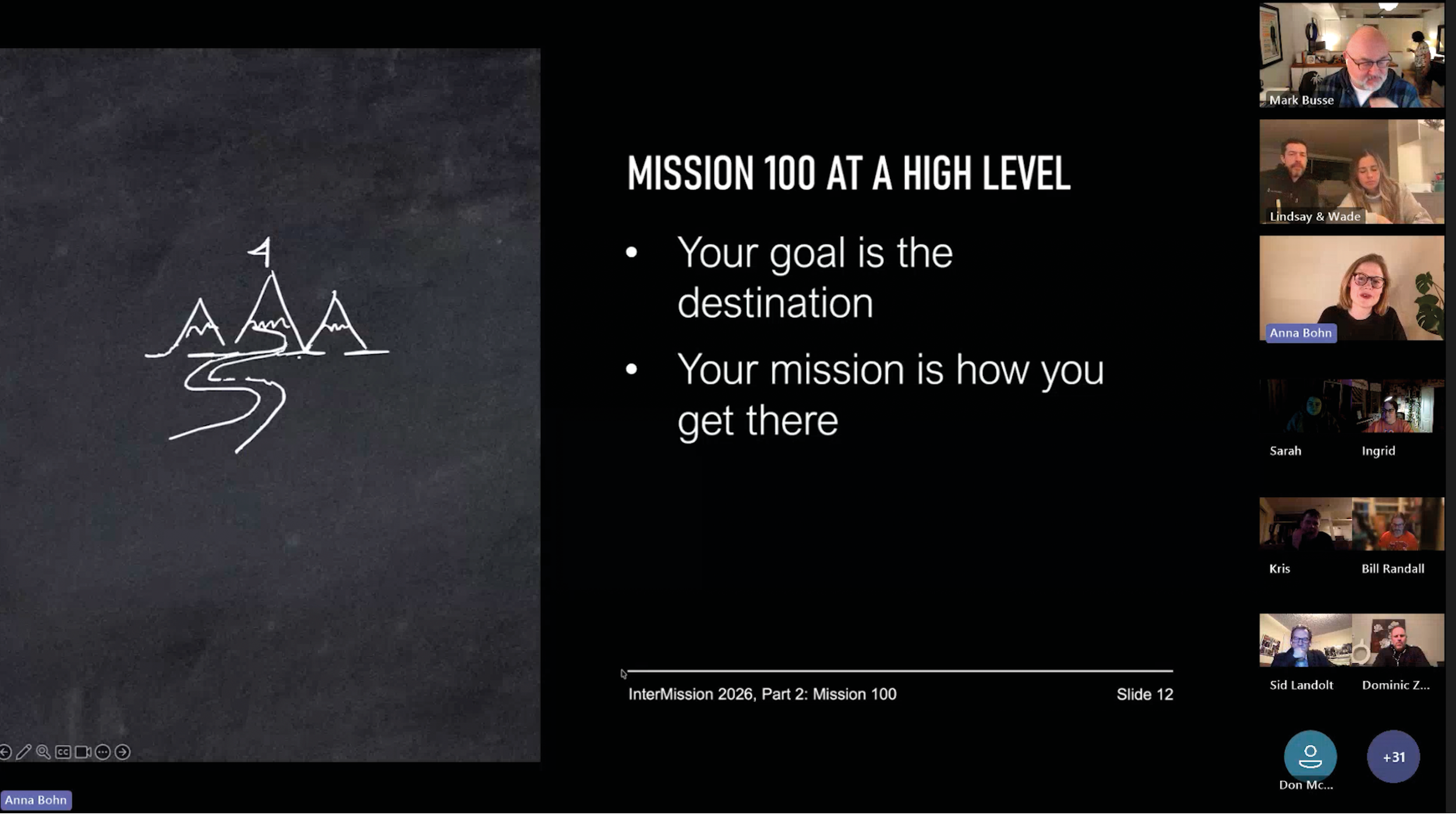
Once we set our goals, the real work begins: making them a reality. Some of our most important goals, however, are outside our direct control. We can’t make someone hire us, promote us, or say yes. But even if we can’t directly influence the outcome, we can improve our odds.
Mission 100 is designed for exactly these kinds of goals. It turns uncertainty into a plan by focusing on impactful, repeatable actions within our sphere of influence.
Two versions of the Mission 100 workbook are below: a digital-first PDF form and print-ready PDF that can be filled out by hand. As always, these materials are free to download, use, and share.
How it works
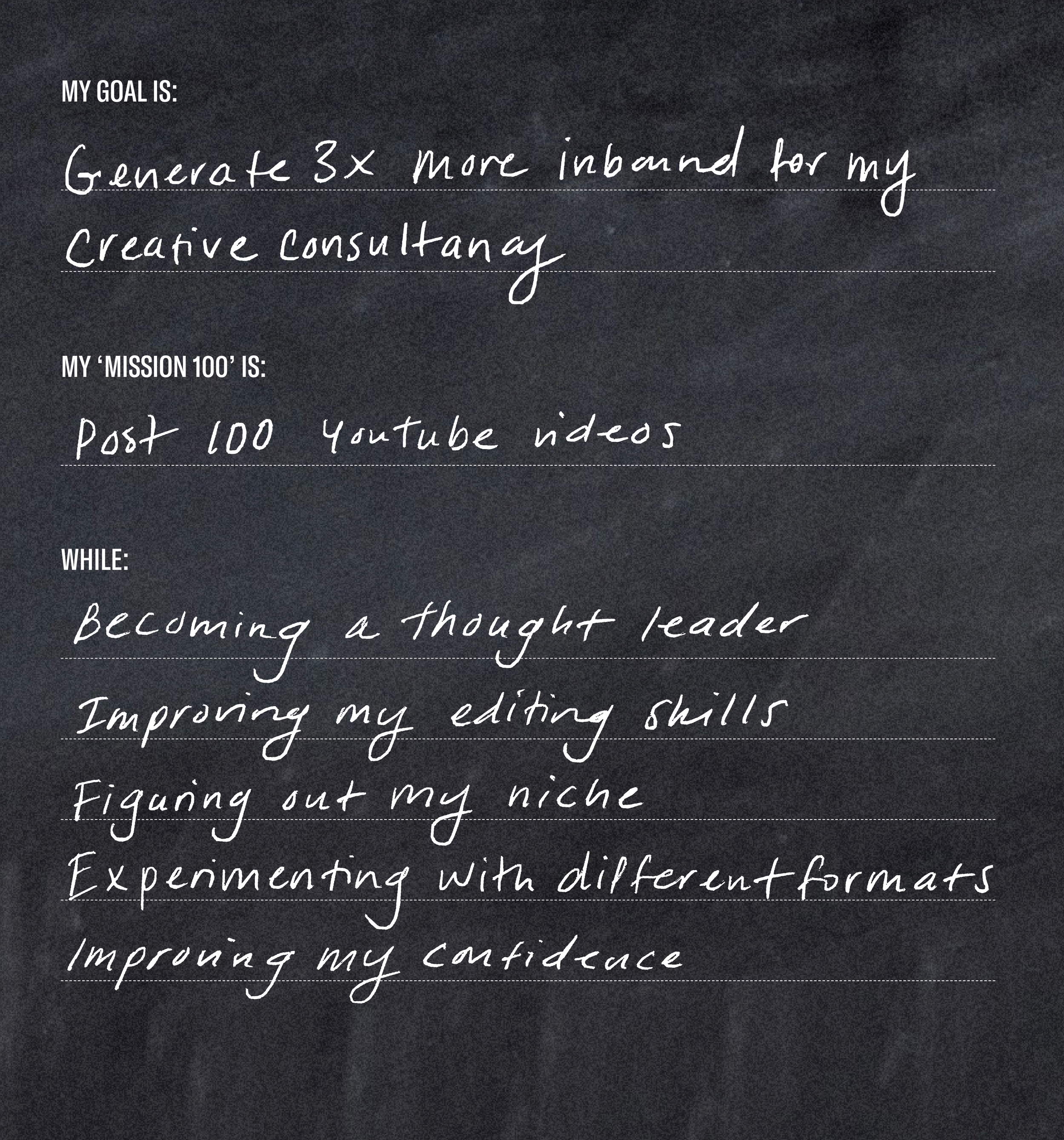
Pick a goal that feels slightly out of reach or whose outcome isn’t fully in your control (for example, “Generate 3x more inbound for my creative consultancy”).
Choose one action that'll improve your odds of success and commit to repeating it a set number of times. This becomes your Mission 100.
Get started. Each time you take action, count it towards your mission—no matter what the result. Your success is tied to effort—not outcomes.
Adjust and improve as you go. By repeating a clearly-defined, high-impact action over and over, you increase your chances of achieving your goal—while seeing what works, adjusting as needed, and learning and growing along the way.
mission 100 in action



How it started
Anna’s Story
In December 2017, I set goals for the coming year: “Meet my life partner” was at the top of the list. But this goal—while heartfelt—was out of my control. So I asked myself: “What’s the one thing I could do, repeatedly, to maximize my chances of success?”
The result was my first Mission 100: “Go on 100 first dates.” (Spoiler: I didn’t succeed because… I got married.) Since then, I—and others—have used Mission 100 for other things. Whatever your goals, I hope you’ll find it helpful, too.

Anna Bohn
InterMission Co-Founder
why it works
1. it maximizes your chances.
Most goals are out of our direct control—as with anything in life, there’s always an element of chance. Shifting our focus to a mission or process that we can influence brings the goal into our sphere of influence—and improves our odds of success.
2. It keeps you focused.
Having a clear mission keeps us focused on the specific actions—the steps, attempts, or shots on net—that move us closer to our goals. Deciding what counts keeps us on track and makes it harder to fall into “productive procrastination” or get distracted.
3. It sets boundaries.
There’s nothing more unsettling than uncertainty. Setting a finite number—25, 50, 100—turns the freeform into something countable and concrete. Doing a Mission 100 helps us mentally prepare to go the distance, pace ourselves, and settle in—knowing exactly what we need to do.
4. It reframes failure.
When we pair an outcome-based goal (like “meet a life partner”) to a process-based mission (“go on 100 first dates”), any attempt is seen as a win, regardless of what happens. Mission 100 emphasizes the number of ‘shots on net,’ keeping us engaged over the long haul.
5. It gives us feedback.
When we focus on each step of the journey (instead of the destination), we can gain something powerful: feedback. Progress accelerates when we see each ‘shot on net’ as an experiment: a chance to try something new, see how it worked, and set a new course if necessary.
6. It’s Additive.
Most resolutions focus on subtraction—“stop doing this, avoid that, cut this out”—which often creates resistance, guilt, and a sense of deprivation. Mission 100 shifts your attention away from what’s missing and toward what’s being created through consistent effort.
7. It gives us a real shot.
When it comes to meeting achieving big goals, our odds may be pretty low. We may need to date ten new people to find a match with potential; we may need to call 10 new companies to get a ‘maybe.’ If we don’t try enough times, we haven’t given our goals a real shot. The more attempts we make, the better our chances.


extra support
mastermind & coaching
This year, we’re offering two new, free, optional supports for InterMission participants: a monthly, facilitated mastermind and one-on-one coaching. Both are intended to support your 2026 goals and Mission 100. If you’re interested in either, please register below.